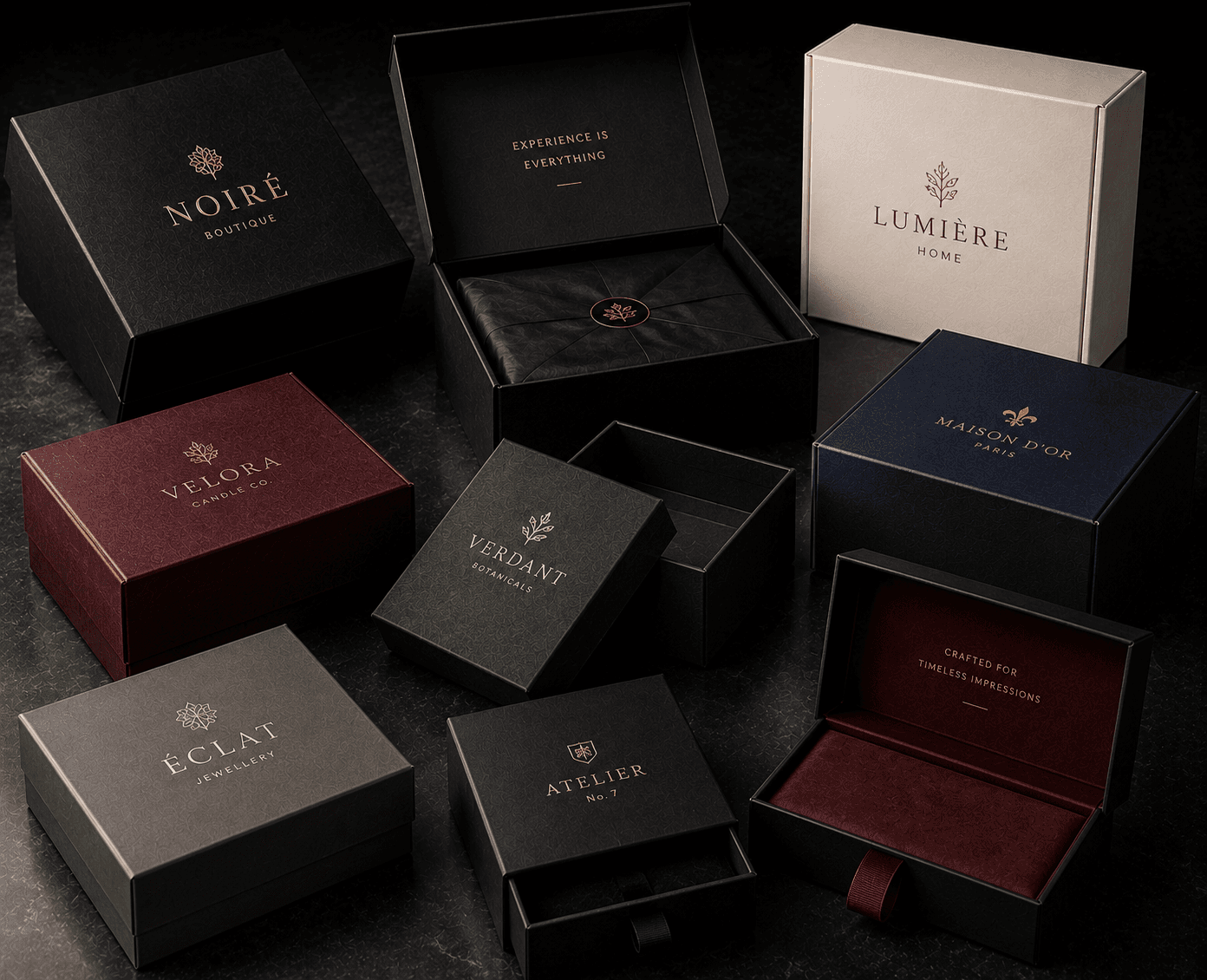
Rigid Boxes vs. Folding Cartons: Which Is Right for You?
Rigid boxes and folding cartons can look similar in a product photo but behave very differently in construction, cost profile and order volume.
Rigid boxes and folding cartons can look almost identical in a product photo — both can be full-colour printed, foil-stamped and finished to a high standard. But they are built differently, cost differently to produce, and make sense at different order volumes. Choosing between them is one of the first structural decisions any brand makes when ordering custom packaging, so it's worth understanding exactly how they differ.
What Rigid Boxes Are
A rigid box is built around a dense chipboard core — typically 2mm to 3mm thick — that holds its shape permanently. That core is then wrapped in a separate outer layer: art paper, kraft, linen texture, velvet or a leather-look finish, each giving the box a different brand character. Because the structure doesn't fold flat, rigid boxes are usually shipped and stored either pre-assembled or in a way that preserves their shape.
Magnetic closure is one of the signature features of this format — neodymium magnets recessed flush into the board, giving the box a deliberate, weighted open-and-close action that sets an expectation before the product is even visible.
What Folding Cartons Are
A folding carton is built from a single sheet of board — commonly SBS, FBB or duplex — that's cut, scored and glued into a structure that folds flat for storage and shipping, then pops or locks into shape at the point of packing. Common styles include straight tuck end, reverse tuck end and auto-lock base constructions. This is the format most retail, consumer goods, food and pharmaceutical packaging is built on, precisely because it stays fully custom-printed while remaining efficient at higher volumes.
Structural and Material Differences
The core difference comes down to what's doing the structural work. A rigid box's strength comes from its chipboard core — the wrap is decorative, not structural. A folding carton's strength comes from the board itself, plus how it's scored, glued and locked together. That's why rigid boxes feel noticeably heavier in hand for a similar footprint, and why folding cartons can be produced and shipped flat until they're needed.
Premium Presentation
Rigid boxes are the format most brands reach for when the unboxing moment itself is part of the product experience — luxury retail, fine jewellery, premium cosmetics and high-end electronics are common categories. The weight, the magnetic closure and the wrap material all contribute to a slower, more deliberate physical interaction. Folding cartons can absolutely be finished to a premium standard too — foil stamping, soft-touch lamination and spot UV are all compatible with folding carton construction — but the underlying board stays lighter, and the unboxing action is inherently faster.
Protection
Both formats can be engineered for protection, but differently. A rigid box's dense core and separate wrap give it inherent rigidity, and inserts — foam, velvet or moulded — can be built to hold a product firmly in place. A folding carton relies more on its fold-and-lock construction and, where needed, an added corrugated layer for heavier or more fragile contents. Neither is automatically "more protective" — the right protection level depends on matching board weight and insert design to what's actually inside.
Storage and Shipping Considerations
This is one of the most practical differences between the two formats. Folding cartons ship and store flat, taking up a fraction of the volume of an assembled box — a real advantage for warehouse space and outbound freight cost at scale. Rigid boxes, because their structure doesn't collapse flat, take up more volume both in storage and in transit. For a brand shipping high volumes through a fulfilment centre, this is a genuine cost and space factor, not just a packaging preference.
Branding and Print Possibilities
Both formats support full-colour offset printing with Pantone (PMS) colour matching, so brand colour consistency isn't a differentiator between them. Rigid boxes offer more surface variety through their wrap material — different papers and textures change the base look before print or finish is even applied. Folding cartons print directly onto the board itself, and can also carry inside-panel print, which rigid boxes can match through custom tissue paper or inner tray print.
Finishing Options
Foil stamping, embossing, debossing, soft-touch lamination, gloss lamination and spot UV are all available on both formats. The practical difference is less about which finishes are possible and more about how they read against each material — a foil-stamped logo on a soft-touch rigid wrap reads differently than the same foil stamp on a folding carton's coated board.
Cost Considerations
Without attaching specific figures, the general cost pattern is consistent across the industry: rigid boxes involve more material and more manufacturing steps per unit — the core, the separate wrap, the assembly — which typically makes them a higher per-unit cost, especially at lower volumes. Folding cartons are manufactured from a single board through a more automated process, which is what makes them increasingly cost-efficient as order volume increases. The right way to compare the two for your project is a like-for-like quote at your actual target quantity, since the gap between them narrows and widens depending on volume, material and finish.
At a Glance
| Factor | Rigid Boxes | Folding Cartons |
|---|---|---|
| Construction | Chipboard core (2mm–3mm) with a separate outer wrap | Single scored, folded and glued board sheet |
| Typical materials | Rigid chipboard, wrap paper, velvet inlay | SBS, FBB or duplex board |
| Closure | Often magnetic (recessed neodymium magnets) | Tuck end, auto-lock base or similar fold-lock closures |
| Feel | Heavier, weighted, slower unboxing action | Lighter, faster to open |
| Ships / stores | Assembled or shape-preserving — more volume | Flat-packed — space and freight efficient |
| Typical MOQ on this site | From 50 units | From 200 units |
| Common use cases | Luxury retail, jewellery, premium cosmetics, electronics | Retail, consumer goods, food, pharmaceutical |
| Finishing | Foil, embossing, soft-touch, spot UV | Foil, embossing, spot UV, gloss/matte lamination |
When Rigid Boxes Make More Sense
- The unboxing moment is a core part of the product experience or brand story
- The product is premium-priced and needs packaging that signals that before it's opened
- Order volumes are lower-to-mid, where the per-unit cost gap to folding cartons matters less
- A magnetic closure or a heavyweight, tactile feel is part of the brand's physical identity
When Folding Cartons Make More Sense
- Order volumes are higher, where per-unit cost efficiency becomes a bigger factor
- Warehouse space and outbound freight cost need to be minimised through flat-pack storage
- The product category — consumer goods, food, retail — is one where folding cartons are the expected, functional standard
- The brand still wants full custom print and finish, without the added cost of a separate wrap and assembly
Key Decision Factors
Boiled down, the decision usually rests on three questions: How premium does the unboxing moment need to feel? What order volume are you actually producing at? And how much does flat-pack storage and shipping efficiency matter to your operation? Answer those honestly and the right structure is usually clear — the two formats aren't competing for the same job.
The Practical Answer
Neither format is objectively better — they're built for different priorities. If the physical weight and closure of the box are part of how your product is meant to feel, a rigid box is doing a job a folding carton can't fully replicate. If you're optimising for volume, storage efficiency and cost at scale while still wanting a fully custom, well-finished box, a folding carton is very likely the better fit. When in doubt, the fastest way to compare them properly is a quote at your actual target quantity and finish spec — that's where the real difference between the two shows up.